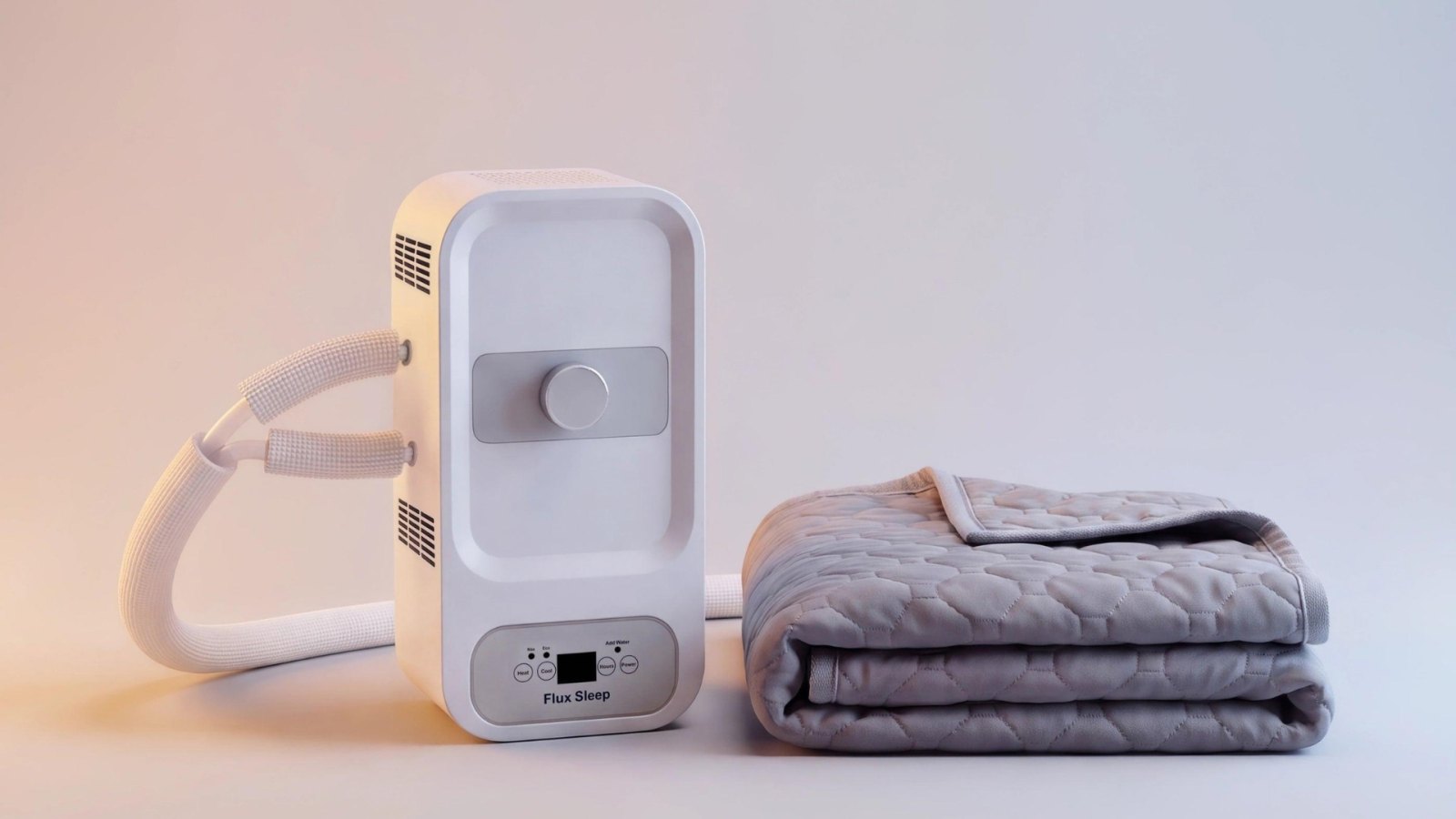
The Flux Sleep Cooling Mattress Pad: A Simple Alternative to Premium Models
One might assume all temperature-controlled mattress pads fit neatly into a category: a mattress topper for a bed, with cooling and heating controls. However, some premium systems are equipped with sleep-tracking dashboards and other features, often locked behind a subscription. While useful in certain scenarios, these options tend to be on the expensive end.
A temperature-controlled mattress pad that costs less than what major brands charge might sound too good to be true. Flux Sleep offers active water cooling and heating at a lower price than many premium systems, without requiring a subscription.
For someone who mainly wants to cool their bed, a less expensive system may do the job without the extra features that come with premium models.
What a Temperature-Controlled Mattress Pad Is
A temperature-controlled mattress pad has a few specific configurations, each with the same goal. One system might not work the same way as another, and the difference might matter to some sleepers. There are passive cooling systems, fan-based systems and active water-cooling systems. Each may be useful, but the third is often most physically effective.
Active water cooling works as one would assume: a control unit either cools or heats water, then circulates that temperature-controlled fluid through small tubes woven through a mattress pad in a constant loop. The pad sits on top of an existing mattress and underneath the fitted sheet. The pad then uses the circulating water to transfer heat from or to the body, depending on whether it is cooling or heating.
Flux Sleep uses solid-state semiconductor refrigeration, specifically the Peltier effect, to cool and heat water. The circulating water helps regulate the bed’s temperature, unlike fan-based or passive cooling pads.
Improving Sleep With Bed Cooling Systems
Sleep is an essential that everyone understands, but few people know what kind of environment best lends itself to restfulness. Some people know they prefer to get into bed in a hotter or cooler environment, but they don’t necessarily understand the impact that their environment might have after they fall asleep.
“As a rule of thumb,” an article from Cleveland Clinic explained, “sleep psychologist Michelle Drerup, PsyD, says to keep your bedroom at 60 to 67°F (15 to 19°C) and to think of your bedroom as your ‘cave.’ ‘It should be cool, dark and quiet to enhance your sleep.’”
A temperature-controlled mattress pad may help individuals create a more restful environment. While scheduling options offered by premium brands may help a sleeper to get in bed at their preferred temperature, the practical alternative provided by Flux Sleep could have similar results for improving sleep.
Setup and Cooling Performance
Setting up the Flux Sleep takes about ten minutes and can be as simple as filling the water reservoir and sliding the pad between the mattress and fitted sheet. Flux states that tap water works fine, but it may be prudent for a sleeper to use distilled water for the long-term health of the system.
The Flux Sleep Water-Cooled Mattress Pad has two modes, Eco and Max, instead of a precise temperature dial. The company states that Eco drops the surface temperature by about 5°F, while Max drops it by about 10°F. It also heats based on the same increments, but cooling tends to be the focus. A 10°F fall might sound subtle, but conductive cooling can feel much more noticeable than ambient air. Flux Sleep claims that Max will reach that 10°F difference within about a 30-minute window.
For couples who prefer different sleeping temperatures, the Queen, King and California King models also offer dual-zone control. Each side has its own cooling unit, so one person can choose Eco while the other uses Max.
Flux Sleep lists the system’s operating noise at 36 decibels, which the company compares to a soft whisper.
Potential Shortcomings for Flux Sleep
While the Flux Sleep mattress pad covers much of what someone would want from a temperature-control solution, there are some features it lacks. For some customers, this won’t be an issue; for others, it may be a reason to choose an alternative option.
One limitation of the Flux Sleep is the lack of precise temperature control. Sleepers are limited to either the 5°F relative change of Eco or the 10°F of Max. If all you need is a setting between “cool” and “cooler,” Flux Sleep may be enough; if you want precise temperature control, it may not be.
The second missing feature is the absence of an app. Several modern brands offer an app for managing temperature precisely or automatically and for tracking sleep data. If this kind of biometric integration appeals to someone, that is a feature that Flux Sleep does not offer. Some premium systems charge subscription fees for connected features, while others include them in the purchase price.
Examining the Differences for Oneself
When boiled down, the biggest differences between Flux Sleep and its competitors are primarily the surrounding features rather than the cooling concept itself. Flux Sleep leaves out the apps and sleep-tracking features found on some premium systems, keeping its focus on basic temperature control at a lower price.
Essentially, a sleeper gives up precision control, scheduling and sleep tracking solutions for a far more cost-effective system. Someone doesn’t necessarily need another connected device in their bedroom just to keep their mattress comfortable. Having a cooler bed is often sufficient. However, a person who favors automation and data integration may have reason to search elsewhere.
Whatever system a person chooses should suit their unique needs as a sleeper. Some people may prefer a premium product with a premium price tag, but for many, a simple system like Flux Sleep may cover all the features they need.
This article is for informational purposes only and does not substitute for professional medical advice. If you are seeking medical advice, diagnosis or treatment, please consult a medical professional or healthcare provider.