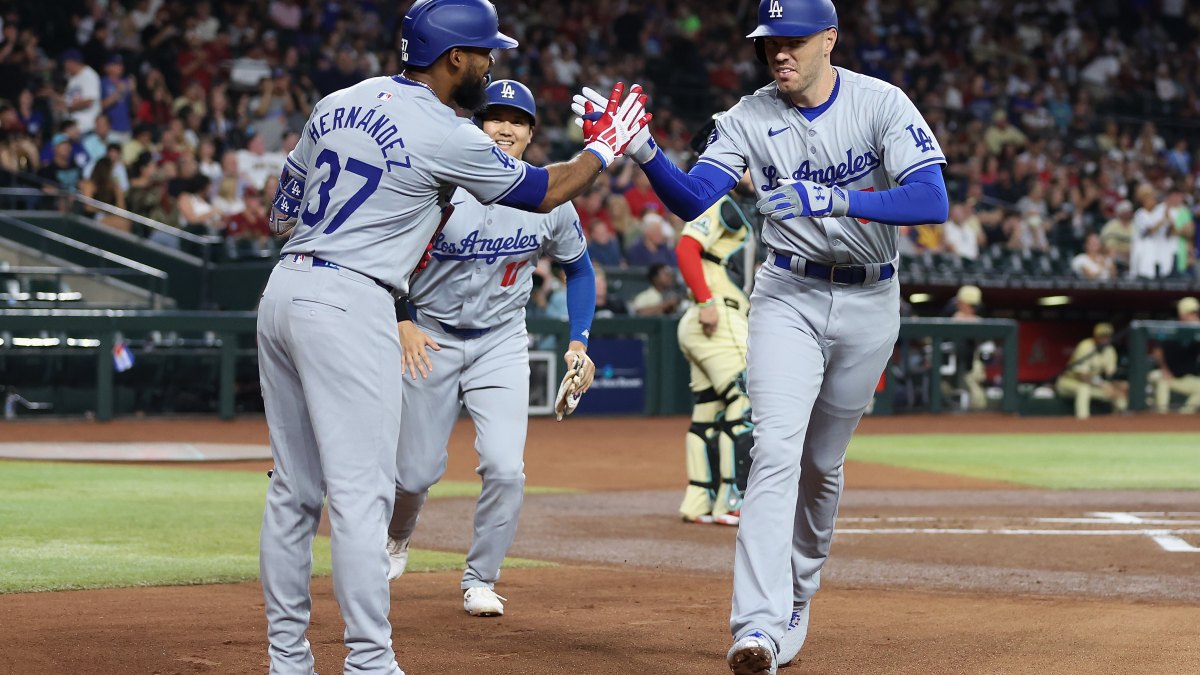
Photo by Christian Petersen/Getty Images
Someone Had to Invent the High Five — Here’s the Disputed Story of How It Happened


You’ve done it a thousand times without ever thinking about where it came from. After a home run, a good meeting or just greeting a 3-year-old — you raise your hand and wait for the slap. The high five feels like it’s been around forever.
It hasn’t. The gesture actually has a traceable — and hotly disputed — origin story.
The high five is one of sports’ most iconic gestures, but its exact origin is still debated. The cast of characters fighting over credit for a simple hand slap is unexpectedly rich — spanning a Dodgers outfielder, a college basketball player and even a 2019 episode of “American Dad.”
Multiple competing stories have emerged over time — some documented, others later disputed or even fabricated.
The 1977 Dodgers Moment Most People Know
The most widely accepted origin story, according to Britannica, traces the high five to Oct. 2, 1977. That’s the day Los Angeles Dodgers left fielder Dusty Baker hit his 30th home run of the season. As Baker rounded the bases and crossed home plate, his teammate Glenn Burke was waiting for him — hand raised high in the air.
Baker didn’t overthink it.

“His hand was up in the air, and he was arching way back,” Baker told ESPN in 2020. “So I reached up and hit his hand. It seemed like the thing to do.”
And just like that — maybe — the high five was born.
Here’s the catch: the interaction was not televised. There’s no video evidence to settle the debate once and for all. But it’s the origin story that stuck, and Burke is widely credited with helping popularize the gesture in professional sports.
The Competing Origin Theories
Here’s where it gets messy. Despite the popular MLB story, historians and cultural references point to earlier or alternative origins.
Some accounts suggest the high five may have existed as a gesture among U.S. military personnel stationed in Japan after World War II. Others note visual similarities in earlier media, including a scene in Jean-Luc Godard’s 1960 film “Breathless” where characters appear to perform a similar gesture.
Another theory ties the gesture to African American Vernacular English, specifically the phrase “gimme five,” suggesting the physical motion evolved from existing cultural expressions. In this reading, the raised hand was an evolution of something already in practice — not an out-of-nowhere invention.
The Basketball Version with the Perfect Quote
In basketball lore, the University of Louisville has its own rival claim — and it comes with the kind of quotable moment that practically begs to be retold.
At a University of Louisville basketball practice during the 1978-79 season, forward Wiley Brown went to give a plain old low five to his teammate Derek Smith. Out of nowhere, Smith looked Brown in the eye and said, “No. Up high.”

The Cardinals were known as the Doctors of Dunk. They played above the rim. Everything about their game was vertical. So when Smith raised his hand, it clicked for Brown: He understood how the low five went against the essential, vertical character of their team.

“I thought, yeah, why are we staying down low? We jump so high,” Brown told ESPN. Brown insists it’s Smith who invented the high five and Smith who spread it around the country.
So Who Really Invented the High Five?
The honest answer: nobody knows for sure. The Baker-Burke story from 1977 is the version most people cite. The Brown-Smith exchange at Louisville has its own passionate defenders. And the theories about military origins and cultural evolution suggest the gesture might not have had a single inventor at all.
Today, while the exact origin remains contested, the high five endures as a universal symbol of celebration — widely used in sports, pop culture and everyday life. The fact that nobody can definitively prove who started it only makes the whole story better.
Now you’ve got the retellable details: Baker’s casual “It seemed like the thing to do.” Smith’s blunt “No. Up high.” And a surprisingly deep debate behind the world’s simplest gesture of celebration.





Conversation
All comments are subject to our Community Guidelines. Life & Style does not endorse the opinions and views shared by our readers in our comment sections. Our comments section is a place where readers can engage in healthy, productive, lively, and respectful discussions. Offensive language, hate speech, personal attacks, and/or defamatory statements are not permitted. Advertising or spam is also prohibited.